
A trading desk for your Mac: charts, order flow, Rithmic execution and a journal, with your own Claude Code or Codex beside you. It reads the market and drafts the order. Unless you say otherwise, nothing is sent until you approve it.
Illustration of the Tessera desk with demo data: a five-minute NQ chart, a DOM ladder and the analyst column. The analyst notes that price reclaimed the flip on 1.8 times the average volume and drafts plan A, a limit buy of 2 NQ at 20,615.00 with a stop at 20,598.00 and a target at 20,700.00, risking $680. The trader approves it on a paper account and it works as a limit order.
Charts, order flow, the ladder, your positions and the analyst share one window. Put panels where you want them; the chart stays the room.
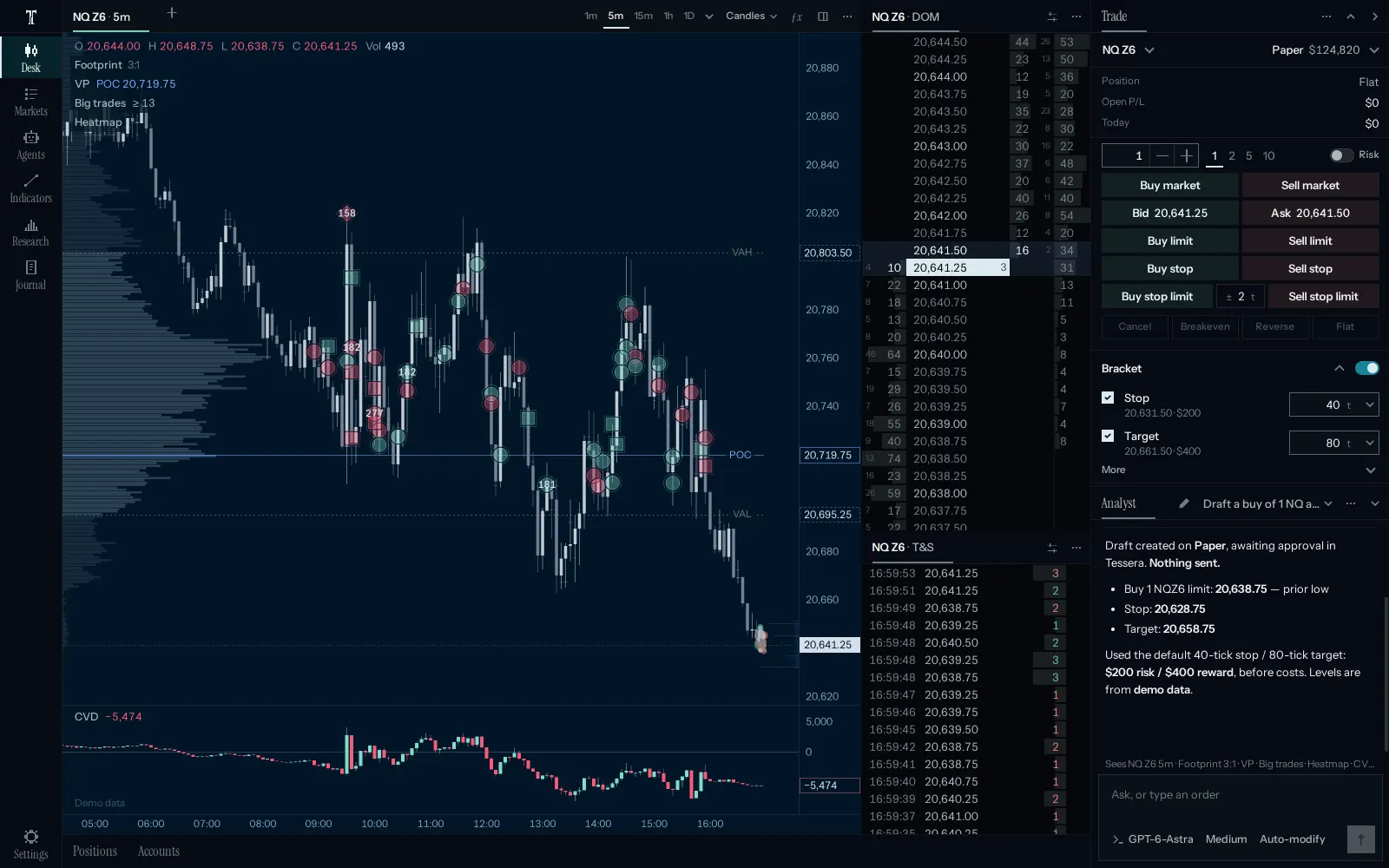
- 01Order flow on the chartFootprints, volume profile, big trades and cumulative delta, drawn on the bars you trade.
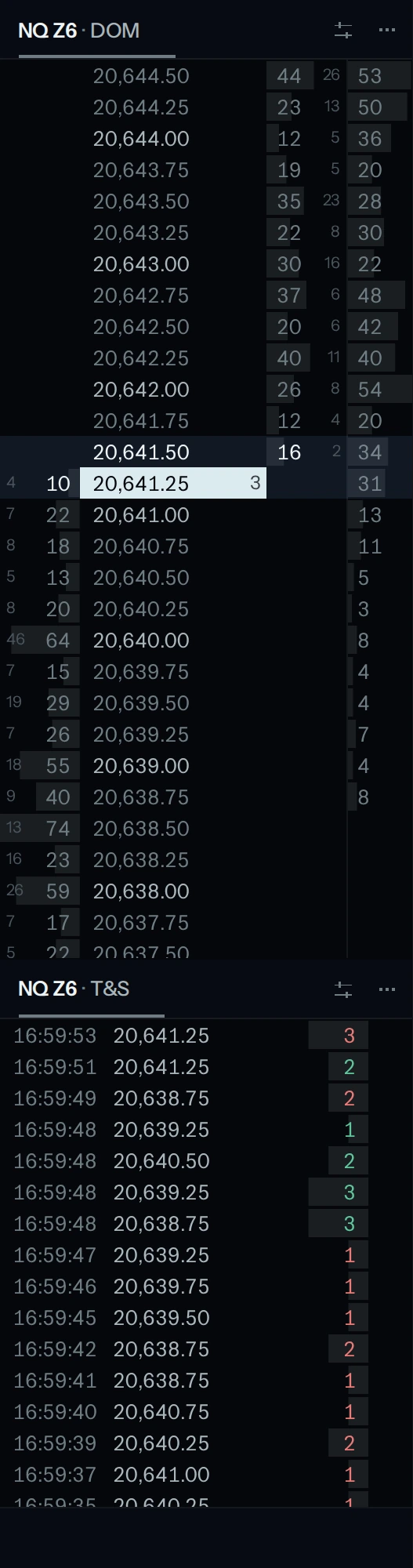
- 02The ladder and the tapeResting size at every tick and every print as it happens, beside the chart they belong to.
- 03Ticket and analyst, one columnOrder entry with brackets above, and the analyst below, reading the same chart you are.
Order flow
Footprints, volume profile, big trades, a liquidity heatmap, cumulative delta, the DOM and time and sales: the order flow a futures trader reads, built in and drawn on the chart.
- 01
Every bar has a story inside it
A candle shows where price went. Order flow shows who took it there, and how hard.
- 02
Footprints
Bid and ask volume at every price inside every bar. Imbalances light up, the busiest price is boxed, and each bar carries its delta.
- 03
Profile, big trades, liquidity
A volume profile with its point of control and value area, bubbles for the large prints, and a heatmap of the depth your feed reports.
- 04
The ladder
Resting size at every tick and your working orders on it, with time and sales beside. Trade from it, brackets attached.
The analyst
A Roman tessera was a token broken in two. Each party kept a half, and only the matching halves proved the bond. Our T is cut the same way: the left half is yours, the right half the analyst's, and its half waits until you set it.
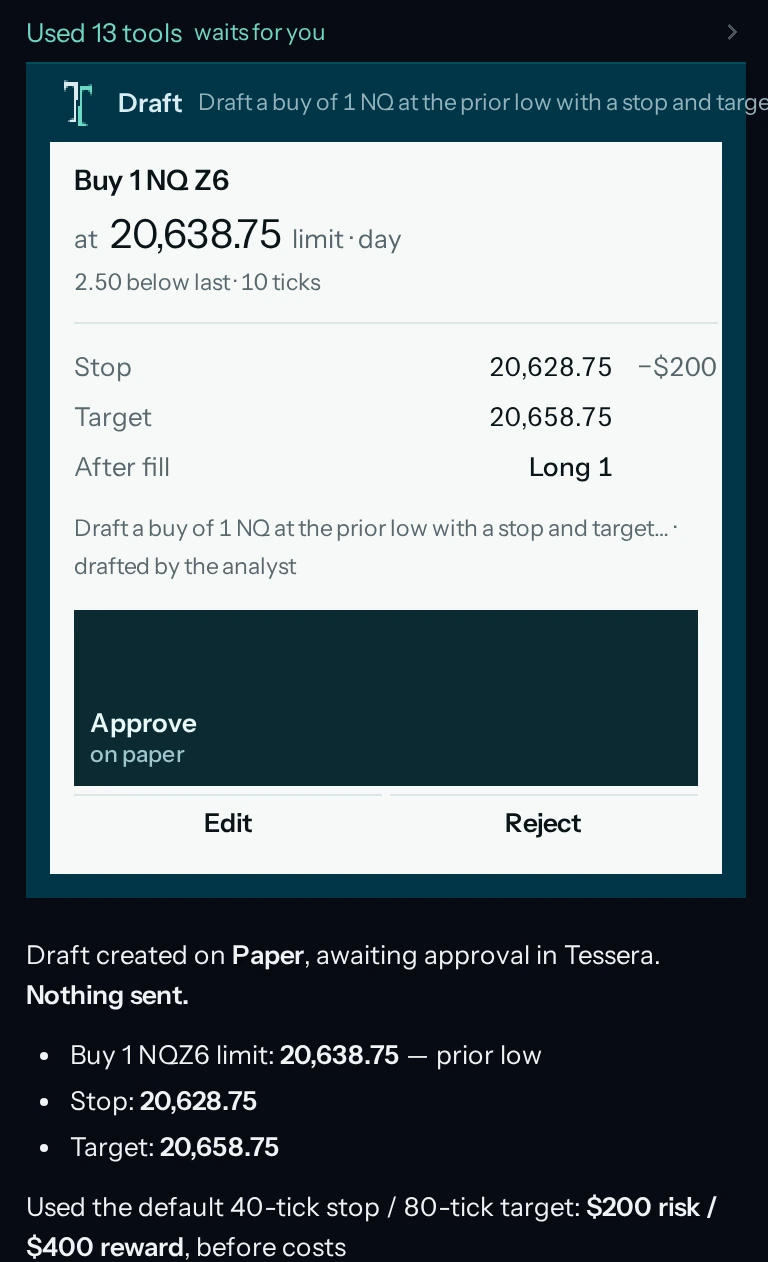
The analyst reads the chart, the levels and the tape, measures what it claims, draws its plan and drafts the order with its stop, target and risk. You approve it, edit it or reject it. How far it may go is a mode, and only you set the mode; the runtime refuses an agent that tries.
- Read only
- Reads and answers. It changes nothing.
- Supervised
- Asks before it changes anything. Every order is a draft for you.
- Auto-modify
- Changes charts, layouts and settings as asked. Every order is still a draft for you.
- Full access
- Places, changes and closes orders without asking. Only you can turn it on, it asks once, and your risk limits still apply.
Claude Code or Codex
The analyst is the agent you already pay for, working inside your desk with the same tools you have. It reads, measures and drafts; it shows every step it took.
Find me a long on NQ for this afternoon and draft it. Paper.
- Read the chartNQ Z6 · 5m · 520 bars
- Read the footprintlast 12 bars · delta and imbalances
- Read the levelsflip, VWAP, prior day
- Measured first touches of the flip61.7% reverted · n = 184
- Drew plan A20,615.00 · stop 20,598.00 · target 20,700.00
- Checked the accountpaper-main · flat
- Drafted the orderBuy 2 NQ Z6 · 20,615.00 limit
Worked for 16.8s · 7 tool calls
14:36 Plan A is drafted on paper-main: buy 2 at 20,615.00, the retest of the flip, stop under it at 20,598.00, target 20,700.00. Risk $680. It waits for you.
Your own subscription
Tessera runs the Claude Code or Codex CLI you already use, signed in to your own Claude or ChatGPT plan. No API keys, no house model in between, nothing extra to buy from us.
Every action is a tool
The analyst works through the same tools you click: charts, drawings, levels, indicators, research, the journal, alerts and order drafts. Each call is shown to you and kept in the audit log.
Or connect over MCP
Any MCP client can drive Tessera through the same tools and the same permission gate as the analyst.
Custom indicators
Write one in a few lines, or ask the analyst to write it for you. It runs over your chart as you type, in Tessera's own engine with nothing to install, and draws like a built-in: legend, settings, styles and labels.
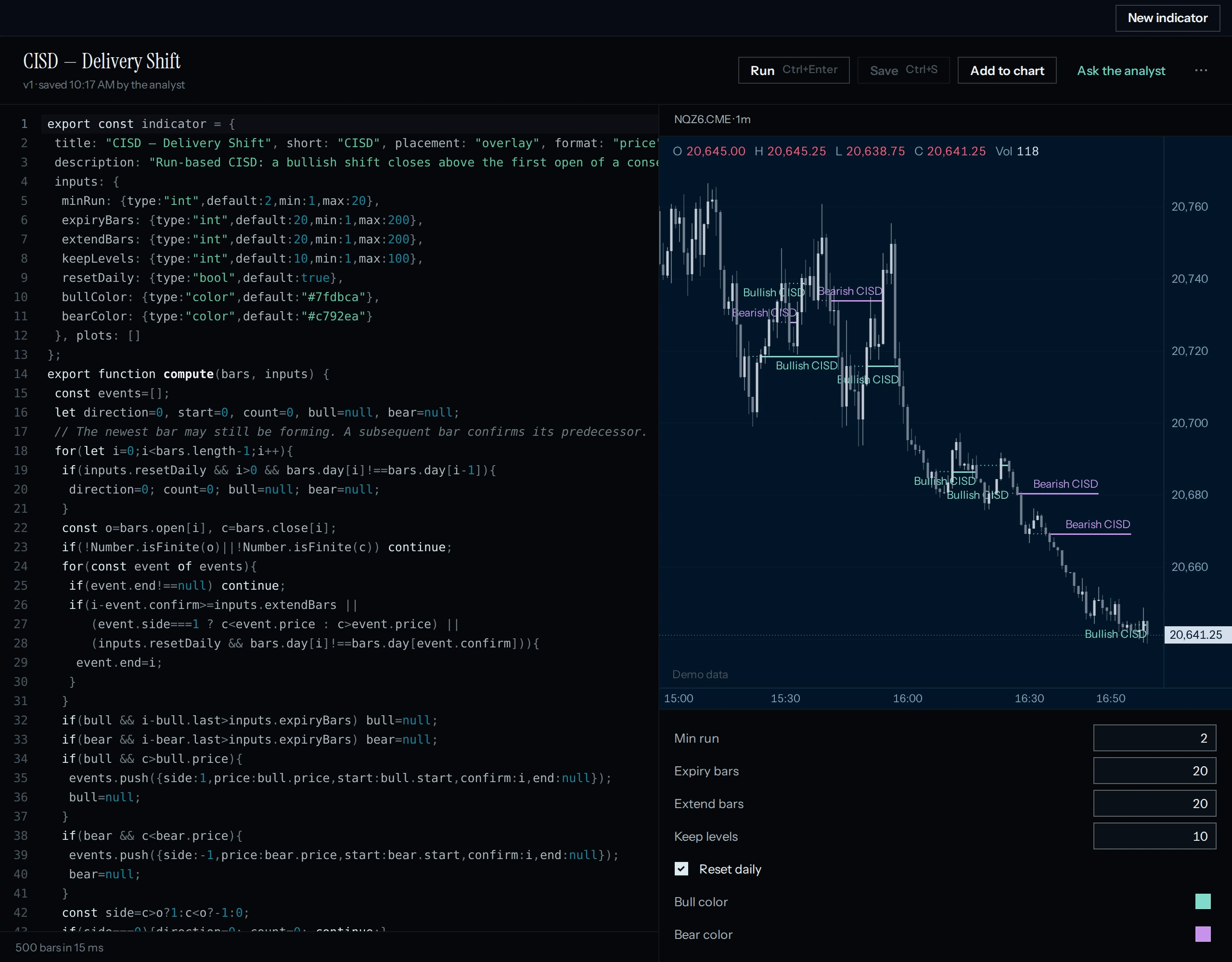
export const indicator = { title: 'VWAP bands', placement: 'overlay', inputs: { mult: 2 }, plots: ['vwap', 'upper', 'lower'],};export function compute(bars, inputs) { const vwap = ta.vwap(bars, { reset: 'day' }); const dev = ta.vwapStdev(bars, { reset: 'day' }); return { vwap, upper: vwap.map((v, i) => v + inputs.mult * dev[i]), lower: vwap.map((v, i) => v - inputs.mult * dev[i]), };}Journal
A journal that fills itself from your fills, replays every trade on its chart, and lets the analyst read it with you.
September 2026 · All accounts
Net P&L
+$4,760.00
Win rate
58.3%
Profit factor
1.86
Expectancy
+$79.33
Trades
60
Fills arrive by themselves
Trades on your connected accounts land in the journal as they fill. Bring history from R | Trader, Tradovate, ProjectX, TopstepX, NinjaTrader or Apex exports, or log one by hand.
Replay any trade
Open a trade on its own chart and watch it play back: the entry, the stop and target, and what price did around them.
Days, analytics, playbooks
Write the day before the open and close it after, read your analytics across every account, and keep the playbooks your setups follow.
Research
Register the hypothesis before the first run. Split your history into a development half and a held-out half, and freeze the rules before you look at the second. Every result comes with its sample size and the variants you tried.
Tessera keeps measured statistics, hypotheses and the analyst's interpretation apart, on the page and in the analyst's answers. A backtest describes the past; it is never presented as a promise about the future.
Fri 2 Oct 2026 · NQ flip study
- Hypothesis registered 09:12, before any run
- First touches of the flip revert more often than chance.
- Measured development half
- 61.7% reverted, against a 51.9% baseline · n = 184 · 2 variants tried
- Measured held-out half, rules frozen
- 58.9% reverted, against 52.4% · n = 96
- The analyst's reading interpretation, not a measurement
- The effect survives out of sample but is smaller. Treat it as a tilt to size with, not a rule.
Execution
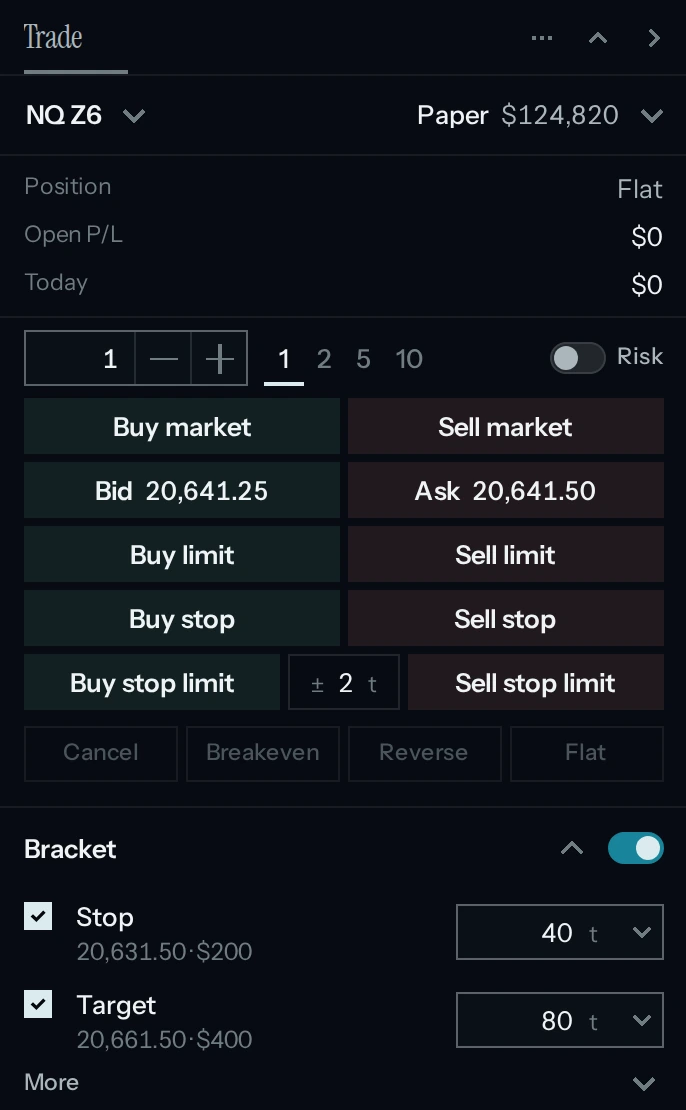
Connect your Rithmic login and trade from the ladder, the ticket or the keyboard. Paper accounts work the same way, so a plan can be rehearsed before it risks a dollar.
Brackets
A stop and a target on every entry, set in ticks or dollars, and carried with the order.
Breakeven
Move the stop to your entry in one click or one key.
Hotkeys
Buy, sell, join the bid or the offer, cancel, flatten and reverse from the keyboard.
Trade copier
Copy a leader account's entries onto your other accounts. Each follower keeps its own bracket, and a fill that differs is said, never evened out.
Alerts and sounds
On price, a level, an indicator line or a line you drew, alone or in sequence. They fire with a sound, a Discord message or a word to the analyst, whether a window is open or not.
Depth and every print
Market-by-order depth and each trade with its aggressor side, straight from the Rithmic feed.
Runs on your Mac
The desk and its runtime run locally. Broker logins stay in the macOS keychain, and orders go from your Mac to your broker.
Sync without credentials
An optional account to sync layouts, templates and conversations between your Macs is planned. It will never carry credentials.
Your data, your AI
Market data comes from your own connections, and the analyst runs on your own subscription. Tessera sells neither.
Tessera is in beta for Macs with Apple silicon. Bring a Rithmic login or start on demo data, and bring your own Claude Code or Codex.